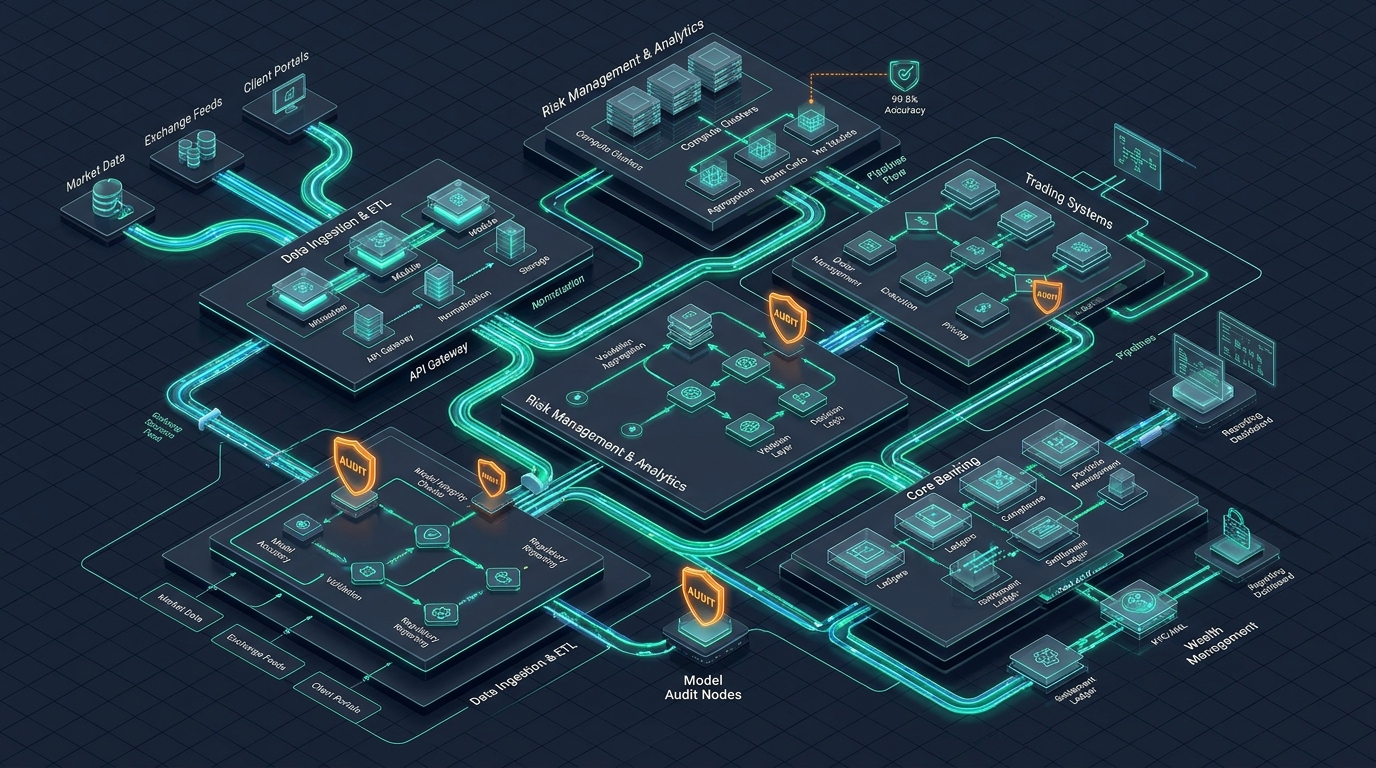
De-Risking Financial Architecture & Workflows
In asset management and financial operations, institutional risk rarely stems from market volatility alone—it frequently originates from hidden operational vulnerabilities: fragile spreadsheet linkages, undocumented legacy workflows, unverified quantitative code, and critical key-person dependencies.
An External Operational Review brings an objective, specialized lens to your firm's operational infrastructure. We conduct deep-dive technical diagnostics across your data pipelines, technology stacks, and operational workflows to ensure regulatory readiness, mathematical integrity, and operational resilience.
Systems Mapping
End-to-end tracing of data pipelines, third-party APIs, legacy databases, and shadow IT to eliminate single points of failure.
Process Codification
Converting undocumented tribal knowledge into standardized, auditable operating procedures (SOPs) and living emergency runbooks.
Model Review & Governance
Mathematical stress-testing, boundary-condition validation, and code-level audits for proprietary R, Python, and Excel models.
Illustrative Use Cases & Proposed Reviews
Systems Architecture & Data Lineage Mapping
Use Case Scenario: A mid-sized fund utilizing multiple disparate market data feeds, legacy accounting SQL instances, and ad-hoc desktop scripts without a unified schematic of data lineages or latency bottlenecks.
Proposed Review: Propose an exhaustive discovery across network endpoints, scheduled jobs, and database triggers to deliver a comprehensive, interactive architectural schematic detailing data dependencies, latency bottlenecks, and single points of failure as a blueprint for high-speed automated pipelines.
Institutional Process Documentation & Key-Person De-risking
Use Case Scenario: Mission-critical daily workflows—such as NAV reconciliation, risk limit monitoring, and investor reporting—relying upon unwritten mental models and individual analyst habits, creating significant key-person risk.
Proposed Review: Propose documenting end-to-end operational paths, producing standardized Standard Operating Procedures (SOPs), step-by-step failover checklists, and interactive runbooks with clear escalation protocols to ensure business continuity regardless of personnel changes.
Quantitative & Algorithmic Model Review
Use Case Scenario: Proprietary quantitative models built in R and Python that have evolved over time without formal code review, version governance, or stress-testing against tail-risk market regimes.
Proposed Review: Propose an independent quantitative audit examining mathematical formulations, boundary conditions, edge cases under volatility shocks, code quality, and data-sanitization routines, delivering an audit-ready Model Validation Report and verified code patches.
Legacy-to-Modern Automation Roadmap
Use Case Scenario: Operations staff spending hours weekly copying data between spreadsheets, email attachments, and legacy reporting portals, resulting in friction and manual entry errors.
Proposed Review: Propose diagnosing friction-heavy touchpoints and designing a phased automation roadmap deploying Python microservices, automated reconciliations, and scheduled ETL scripts to eliminate manual entry while preserving audit logging.
Strengthen Your Operational Foundation
Discover hidden operational friction, safeguard proprietary models, and transition to institutional-grade automated workflows.